 CINCINNATI, OH – America’s first anarchist. A séance‐leading abolitionist. A cult who believed that the oceans would turn to lemonade and humans would grow “long and useful tails.” Each of these was responsible for founding strange, remarkable, idealistic communities in Ohio in the 1840s. And all three communities were founded in the same location: 30 miles east of Cincinnati in a place known as Utopia, Ohio. And for the first time, their story is being told in dramatic form.
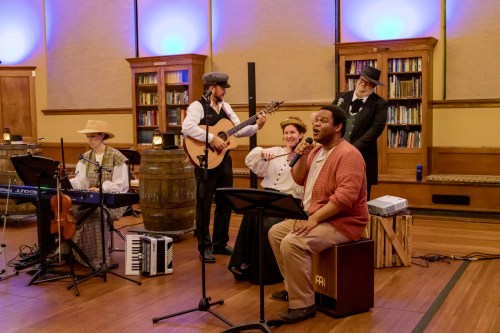
UTOPIA, OHIO is a new musical following the rise and fall of three little‐known utopian experiments through the voices of individuals whose lives led them there: a widowed woman shoemaker, a Black man who escapes enslavement with his family and a Jewish immigrant fleeing persecution. Featuring gifted actors playing their own instruments and a bevy of historical images, the musical bursts with emotion and longing felt by everyday people marginalized in the young and rapidly changing United States.
Written and produced by award‐winning Cincinnati theatre artist Joshua Steele, UTOPIA, OHIO will be performed four times at The Carnegie Center of Columbia Tusculum in Cincinnati (3738 Eastern Avenue, 45226):
- Thursday, August 3, 7:30pm
- Saturday, August 5, 7:30pm
- Wednesday, August 9, 7:30pm
- Thursday, August 10, 7:30pm
- Sunday, August 13, 2:00pm
Tickets are $24 ($12 students) and may be purchased at www.eventbrite.com/e/utopia-ohio-a-new-musical-tickets-632114099287
UTOPIA, OHIO is produced by Hugo West Theatricals (HWT) in association with Falcon Theater.
The Brief & Fascinating History of Utopia, Ohio
The 1840s were a time of great change in the young United States. The Industrial Revolution was rapidly changing the country’s agrarian, craft‐based economy into one of cities and factories. And already festering were the moral rifts over chattel slavery that would soon tear the country in two. Many common folks felt forgotten and left behind, leading them to search for meaning and livelihood wherever it could be found.
Enter communalism, the concept that by living and working together in small havens, folks could create their own utopia. Communes were founded across the US in the early 1800s with many different belief systems, but it was just east of Cincinnati, Ohio where three distinct social experiments happened in the same place between 1844 and 1847.
Clermont Phalanx – The largest American communal movement was based on the writings of Charles Fourier, a French philosopher and scientist. Fourier believed that by dividing society into “phalanxes” of 1,620 individuals each, with all residents doing work they were naturally attracted to, humanity would enter a golden age that would see disease eliminated, the entire planet warming to a tropical climate, the sea turning to lemonade and humans growing “long and useful tails.”
In 1844, a group of Cincinnatians formed a phalanx of their own, purchasing 900 acres on what is today the tiny hamlet of Utopia, Ohio. Like most phalanxes before it, the Clermont Phalanx quickly failed due to financial and legal troubles, as well as purported “jealousy” among the women of the settlement.
Excelsior – When the Clermont Phalanx dissolved, the land was quickly purchased by another group with communal goals. John Wattles, a noted pastor and lecturer, came to Cincinnati to study with Lyman Beecher, father of Harriet Beecher Stowe. Among other beliefs, Wattles was an abolitionist and a spiritualist, who believed he could commune with spirits of the dead. He founded the settlement of Excelsior in 1847.
Against the wisdom of farmers in the area, Wattles believed that the common house built by the Clermont Phalanx should be moved to the banks of the Ohio River. Twelve days before Christmas in 1847, during a dance at the common house, the river flooded, trapping the revelers in the structure. 17 communalists died that day, including four African Americans, presumed to be members of the abolitionist community. The settlement never recovered from this tragedy.
Utopia – Around the same time that John Wattles formed his community on the central plot of the erstwhile Clermont Phalanx, the eastern plot was acquired by a group led by philosopher and renaissance man Josiah Warren. After participating in other communal experiments, Warren believed that individualism was the key to a fruitful society. Known as “America’s first anarchist,” Warren founded Utopia on three basic premises. First, the village had no laws. All citizens were expected to weigh the consequence of their own actions. Second, there was no established religion. And third was Warren’s economic principle of “equitable commerce,” which held that no goods or services should be sold at a
profit, and that labor notes (which promised work in exchange for goods or services) replaced traditional currency.
Though the formal settlement of Utopia was short‐lived, residents who made the area their home would practice equitable commerce principles for decades to come.
Northern Kentucky University masters graduate, Cori Flatt, co‐authored the 2019 article “Utopia, Ohio, 1844–1847: Seedbed for Three Experiments in Communal Living” in the journal American Communal Societies Quarterly. It provides an outstanding study of the communal experiments at Utopia. Flatt has also consulted on the development of the musical UTOPIA, OHIO.
Today, Utopia, Ohio consists of a handful of houses, a convenience store and a historical marker; barely a blip as one travels along US 52. Some say the ruins of an underground chamber at the site, likely a fermenting cellar for a 19th century vineyard, is haunted. The chamber appears in several guidebooks and websites for haunted Ohio locations.
It Takes A Village
UTOPIA, OHIO is written and produced by award‐winning theatre artist Joshua Steele. Manager of Cincinnati’s historic Memorial Hall and a voice instructor at Northern Kentucky University’s School of the Arts, Steele is also an active playwright, having written or co‐written five plays and musicals that have appeared at the Cincinnati and Indianapolis Fringe Festivals, the Cincinnati Art Museum and Falcon Theater in Newport, KY. He and collaborator, Mike Hall, write and produce their shows under the banner of Hugo West Theatricals.
“I first learned about Utopia on a Cincinnati history Facebook group,” explains Steele. “The story instantly captured my imagination, as it does for all who come into contact with Utopia. Nearly unbelievable in its wild ideas, the history is alternatingly outlandish, romantic, tragic, political and mystical. Utopia is a story that begs to be told, and has been a stage adaptation waiting to happen.”
UTOPIA, OHIO will feature a gifted company of actor‐musicians who all play their own instruments as they inhabit the historical characters of the show. Zack Steele* (MFA Directing candidate at Penn State University) directs the show and plays the role of Jewish immigrant, Moishe. Steele will draw on his extensive career as a professional director actor‐musician (RING OF FIRE, HANK WILLIAMS: LOST HIGHWAY, PUMP BOYS & DINETTES) as he grapples with the unique challenges of through‐composed (all music, limited dialogue) piece. Assisting him and providing background research on the piece is Deondra Kamau Means, a decorated theatre artist and Playwright in Residence at The Children’s Theatre of Cincinnati. Means brings a wealth of expertise in the Black American experience, having developed new
works including LEWIS, CLARK & YORK and HARRIET TUBMAN: STRAIGHT UP OUTA THE UNDERGROUND about important Black figures in American history.
Leading the cast is accomplished stage and screen actor, Jennie Malone* (Role of Sarah). A veteran of more than 50 regional theatre productions across the country, Malone has enjoyed particular success as an actor‐musician, utilizing an impressive array of instrumental talents including keyboard, guitar, accordion, bass, ukelele, mandolin and others. She has appeared in internationally distributed films including Mark Ruffalo’s Dark Waters, Our Scripted Life and Wrong Turn, as well as the television series Nashville.
Brad Myers plays the leaders of each of the three settlements while providing the musical foundation for the show as one of the region’s finest guitarists. A faculty member at the University of Cincinnati College‐Conservatory of Music, Myers is also an actor‐musician whose professional credits have included PUMP BOYS & DINETTES (The Carnegie), HOT DAMN! IT’S THE LOVELAND FROG (Cincinnati Fringe Festival) and RING OF FIRE (Memorial Hall).
Recent Northern Kentucky University graduate Jeremiah Savon Jackson makes his professional debut with UTOPIA, OHIO as Samuel, a Black man who escapes enslavement with his young family. Rounding out the tight cast of five is Disney Cruise Lines entertainer and busy actor‐musician Linsey Rogers, who plays both fiddle and keyboard and will inhabit multiple roles throughout the show.
Full artist biographies are included at the end of this release.
KICKSTARTER CAMPAIGN
The company of UTOPIA, OHIO are seeking supporters for their Kickstarter campaign, which seeks to raise money to defray production costs including venue rental, costumes, props and artist stipends. As of this writing, the campaign has secured pledges representing 50% of its $2,000 goal. The campaign runs through July 12, 2023.
The Kickstarter campaign can be found here: https://www.kickstarter.com/projects/hugowest/utopia‐ohio‐a‐new‐musical
UTOPIA, OHIO CAST AND DESIGN TEAM
Sarah – Jennie Malone*
Samuel – Jeremiah Savon Jackson
Moishe – Zack Steele*
Lougborrow, Wattles, Warren – Brad Myers
Mackenzie, Conductor, Esther Wattles, Elizabeth Seaver – Linsey Rogers
Director – Zack Steele
Assistant Director & Dramaturg – Deondra Kamau Means
Costumer – Jim Stump
Stage Manager – Clare Jaymes
Producer – Joshua Steele
Graphic Design – Greg Glevicky
* The Actor appears through the courtesy of Actors’ Equity Association, the Union of Professional Actors and Stage Managers in the United States
About Hugo West Theatricals
Hugo West Theatricals is the lunatic hobbyhorse of Cincinnati‐based writing and producing team Mike Hall and Joshua Steele. Called “smart playwright[s] who know how to surprise an audience in unexpected ways,” their often sold‐out productions have been dubbed “smart and funny, amiable and high energy” (River City News), “riotously funny but infectiously endearing” (Cincinnati Citybeat) and “unexpectedly entertaining and thoughtful” (National Review). More about their work can be found at https://www.hugowesttheatricals.com/.
Founded in 2012, HWT has produced award‐winning stagings of original, adapted and existing works, with a special interest in remarkable Cincinnati history topics. Their production history includes DON’T CROSS THE STREAMS: THE CEASE AND DESIST MUSICAL; A KLINGON CHRISTMAS CAROL; HOT DAMN! IT’S THE LOVELAND FROG!; ZOMBIE‐LOGUE; CESSNA; THE LETTERS OF VINCENT VAN GOGH: A LIVE PERFORMANCE; SUMATRAN RHINO; THE GOSPEL OF BARABBAS and HARAMBE. Their works have appeared at The Cincinnati and Indianapolis Fringe Festivals, The Art Academy of Cincinnati, the Cincinnati Art Museum and Falcon Theater (Newport, KY).
UTOPIA, OHIO is the group’s ninth original work and third original musical.
About Falcon Theater
Non‐profit theater company Falcon Theater serves as fiscal agent for Hugo West Theatricals’ production of UTOPIA, OHIO. Founded in 1989 by Dave Radtke and Ted Weil, Falcon Theatre began as an aspiration to expand the theatrical opportunities in the Greater Cincinnati area. Since that time, Falcon has built on its founding mission by providing eclectic, diverse theatre experiences to Cincinnati and Northern Kentucky. Falcon Theatre has created a tradition of exceptional theater and is an intrinsic part of the flourishing Greater Cincinnati Theater community. Falcon is dedicated to both artists and audiences as the relationship between the two is what makes live theater such an extraordinary art.
Falcon first took the stage in the fall of 1989 at Westwood Town Hall, an historic building run by the City of Cincinnati as a recreation and arts center. After 14 years in the heart of Westwood, Falcon relocated to the Monmouth Theater in Newport, Kentucky. Planned as a temporary move, Newport became a neighborhood we could call home. In October 2014, that temporary residence became our permanent home when we purchased the Monmouth Theatre building and renamed it Falcon Theatre.
Since Falcon’s inception, it has evolved from simply “the spunky little upstart” theater producing 2 shows a year into a dedicated arts organization expanding beyond our stage into outreach programs including Falcon Takes Flight, Falcon’s Fourth Wall, HIVoices® and the upcoming Falcon Play Incubator. Each of these initiatives as well as our larger main stage season allow us to be involved at a more personal, community level.
As a member of the League of Cincinnati Theaters, Greater Cincinnati’s professional theater alliance, Falcon is committed to growth and promotion of a unified arts scene in Greater Cincinnati. Through this association with theaters including Playhouse in the Park, Ensemble Theater of Cincinnati, Cincinnati Shakespeare Company and Know Theatre of Cincinnati (just to name a few), Falcon continues to be a cynosure of Greater Cincinnati’s vibrant theater scene.
 HOT DAMN! IT’S THE LOVELAND FROG!


 UTOPIA, OHIO – A New Musical

 Behind the Curtain Cincinnati